The role of cloud phase in Earth's radiation budget

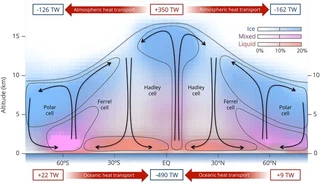 Image credit: NASA CloudSat/CALIPSO A-Train Constellation
Abstract
This study provides a comprehensive global assessment of how liquid, ice, and mixed-phase clouds contribute to the Earth’s top-of-atmosphere (TOA) radiation budget. Utilizing 5 years of spaceborne radar and lidar observations from the NASA A-Train constellation (specifically CloudSat and CALIPSO), we isolate the distinct shortwave and longwave radiative impacts belonging to individual cloud phases. Globally, liquid clouds dominate the shortwave cooling effect, while ice clouds provide the primary longwave greenhouse warming component. Mixed-phase clouds, though geographically constrained primarily to high-latitude storm tracks, exert a significant net cooling influence on the climate system. By establishing an observationally constrained baseline of phase-partitioned cloud radiative effects (CRE), this work highlights critical sensitivities in how energy is distributed across the global climate system and provides a vital benchmark for evaluating cloud-phase parameterizations and feedback loops within next-generation climate models.
Type
Publication
Journal of Geophysical Research: Atmospheres
This research establishes an observational framework to decompose the Earth’s Top-of-Atmosphere (TOA) Cloud Radiative Effects (CRE) by thermodynamic phase, isolating the unique roles played by liquid, ice, and mixed-phase clouds.
Key Takeaways
- Global Radiative Baselines: Liquid water profiles remain the heaviest driver of solar planetary albedo cooling, while ice clouds act as the dominant atmospheric thermal greenhouse traps.
- The Mixed-Phase Impact: Mixed-phase structures are shown to exert strong, disproportionate net cooling spikes concentrated along mid-to-high latitude marine storm tracks.
- Model Benchmarking: Offers an absolute, multi-year active sensor validation record designed to pinpoint and correct systematic phase-transition biases within global climate simulation runs.
Cloud Radiative Effects
CloudSat & CALIPSO
Earth Radiation Budget
Cloud Phase Partitioning
Remote Sensing

Authors
Weather Analyst / ML Researcher
I am an Atmospheric Scientist and Machine Learning Researcher at NASA Goddard Space Flight Center / UMBC. My work focuses on pushing the limits of weather, climate, and environmental predictability by combining massive multi-sensor satellite observations, high-performance computing (HPC), and advanced machine learning architectures.