Observation-Based Radiative Kernels From CloudSat/CALIPSO

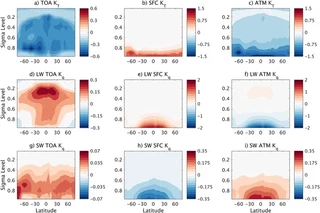 Image credit: NASA CloudSat/CALIPSO active atmospheric vertical profiling
Abstract
Radiative kernels describe the differential response of top-of-atmosphere and surface radiative fluxes to small perturbations in climate state variables, serving as a widely adopted method to quantify climate feedbacks. Traditionally, these kernels are constructed using simulated atmospheric states from General Circulation Models (GCMs), inherently introducing structural model biases into feedback calculations. Here, we present the first set of observation-based radiative kernels for temperature, water vapor, and surface albedo perturbations. These kernels are built directly using a data base state from the fifth release of the CloudSat level-2 fluxes and heating rates dataset (2B-FLXHR-LIDAR), which blends active radar and lidar profiles from the A-Train satellite constellation. By utilizing an empirically observed atmospheric baseline rather than a model simulation, these kernels provide a neutral benchmark for assessing climate sensitivities in observation records and model ensembles alike. Furthermore, we demonstrate that properly accounting for the vertical distribution of cloud masking within an observational framework is vital for correctly interpreting the magnitude and sign of longwave cloud feedbacks.
Type
Publication
Journal of Geophysical Research: Atmospheres
This research establishes a framework for evaluating global climate feedbacks by replacing standard model-derived radiative kernels with observational profiles constructed from the A-Train satellite track.
Key Innovations & Framework Updates
- Elimination of GCM Base-State Bias: Traditional climate sensitivity diagnostics inherit systematic discrepancies from model assumptions. This tool uses empirical vertical measurements to ensure a neutral diagnostic base state.
- Active Sensor Synergy: Built upon high vertical-resolution measurements from the 2B-FLXHR-LIDAR multi-sensor product, mapping distinct layers of the atmosphere simultaneously.
- Cloud Masking Corrections: Clarifies longwave feedback mechanics by mapping exactly how cloud layers interact with, mask, and structurally alter the flux signals of non-cloud climate variables.

Authors
Weather Analyst / ML Researcher
I am an Atmospheric Scientist and Machine Learning Researcher at NASA Goddard Space Flight Center / UMBC. My work focuses on pushing the limits of weather, climate, and environmental predictability by combining massive multi-sensor satellite observations, high-performance computing (HPC), and advanced machine learning architectures.