The Role of Precipitation Variability in Closing the Global Atmospheric Energy Budget

Key Points
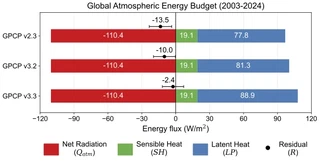
- 98% Mean Energy Closure: The transition to GPCP v3.3 successfully shrinks the multiannual atmospheric energy budget residual down to -2.4 ± 9.5 W/m², a stark improvement over the legacy v2.3 baseline of -13.5 ± 10.0 W/m².
- The Variability Trade-Off: Tightening the long-term mean agreement inadvertently amplifies short-term interannual variability within the budget residual, exposing a structural trade-off between baseline accuracy and anomaly stability.
- Tropical Forcing Hotspots: This shifting year-to-year variability is geographically anchored to localized convective adjustments in the Tropical Western Pacific, likely resulting from superior identification of high-intensity convective storm extremes.
Plain Language Summary
While a warmer atmosphere can hold more moisture, the Earth’s energy budget ultimately dictates the global amount of rainfall. For rain to fall, the atmosphere must release heat, primarily by radiating energy into space. This study investigates how well independent satellite observations of rainfall and atmospheric radiation align with this physical constraint.
By comparing three generations of the Global Precipitation Climatology Project (GPCP) data, we found that the latest version (v3.3) brings the global water and energy cycles into much closer agreement than previous versions, reconciling the budget within 98%. However, we also discovered a trade-off: as the data became more accurate at representing average global rainfall, it yielded greater year-to-year changes. This increased variability is tied to how the new version tracks heavy rainfall in the tropical Western Pacific.
We identified a 2-month phase lag between rainfall and the atmosphere’s ability to shed heat, creating temporary non-physical imbalances in the global energy budget. Our findings suggest that while the newest precipitation records are excellent for understanding the Earth’s average state, we must be cautious when using them to study short-term climate swings. This work is a critical step toward ensuring satellite tools can accurately track changes in Earth’s atmosphere.
