The Role of Clouds in Modulating Global Aerosol Direct Radiative Effects in Spaceborne Active Observations and the Community Earth System Model
Apr 15, 2015· ,,,,·
1 min read
,,,,·
1 min read
Alex Matus
Tristan S. L'Ecuyer
Jennifer E. Kay
Jean-François Lamarque
C. Hannay
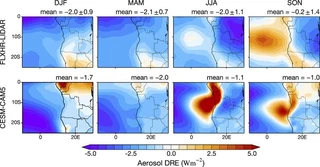 Image credit: NASA A-Train Satellite Constellation tracking aerosols and clouds
Abstract
This study investigates how global cloud cover modulates the aerosol direct radiative effect (DRE) by pairing multiyear active satellite sensor observations with global climate simulations. Utilizing data from the NASA A-Train constellation—specifically combining CloudSat’s radar and CALIPSO’s lidar frameworks via the 2B-FLXHR-lidar product—we derive an observationally constrained global estimate of all-sky and clear-sky aerosol DRE. These empirical data are directly compared against simulations from the Community Earth System Model (CESM1/CAM5) to evaluate the model’s capacity to resolve aerosol-radiation-cloud interactions. Crucially, the presence of clouds reduces the global-mean top-of-the-atmosphere (TOA) cooling effect of aerosols by masking underlying particles, though dark absorbing aerosols aloft can trigger localized warming when suspended above bright, low-level stratocumulus decks. By analyzing regional hotspots in the southeastern Pacific and southeastern Atlantic, this work identifies systematic biases in model cloud fractions and aerosol vertical placements, providing a robust pathway to improve aerosol climate forcing parameterizations in Earth system frameworks.
Type
Publication
Journal of Climate
This research provides an observation-based baseline to quantify how multi-layered cloud fractions modulate, mask, or amplify the Direct Radiative Effects (DRE) of global aerosol burdens.
Key Methodology & Findings
- A-Train Data Fusion: Integrates vertically resolved profiles from CloudSat and CALIPSO into a unified flux model, bypassing traditional limitations found in column-integrated passive satellite datasets.
- The Cloud Masking Mechanism: Quantifies the global dampening footprint where ambient low-level cloud shields diminish the negative shortwave cooling signal of scattering aerosols.
- Absorbing Aerosols Over Clouds: Highlights localized top-of-atmosphere thermal trapping hotspots—such as biomass burning smoke plumes drifting above marine stratocumulus sheets in the southeastern Atlantic.
- CESM1/CAM5 Benchmarking: Uncovers structural model variations in cloud placement and multi-layer masking configurations, providing target validation boundaries for climate forecasting models.
Aerosol Direct Radiative Effects
CloudSat & CALIPSO
CESM Model Evaluation
Radiative Transfer Modelling
Climate Forcing

Authors
Weather Analyst / ML Researcher
I am an Atmospheric Scientist and Machine Learning Researcher at NASA Goddard Space Flight Center / UMBC. My work focuses on pushing the limits of weather, climate, and environmental predictability by combining massive multi-sensor satellite observations, high-performance computing (HPC), and advanced machine learning architectures.